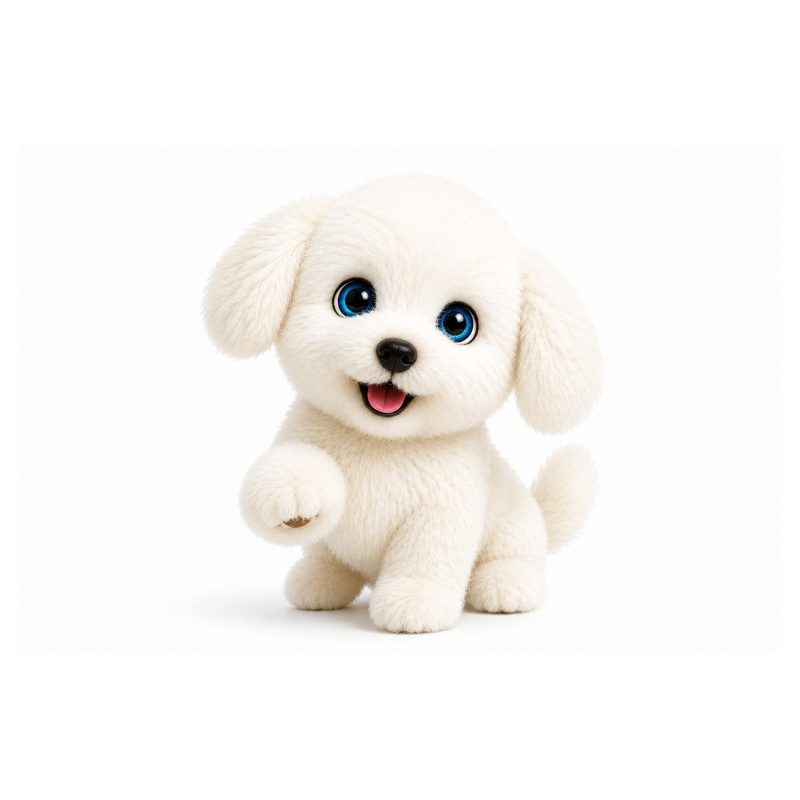
If you are shopping in the softer end of the category, the maths looks very different. A companion robot built into a plush body — what the market now calls an ai plush toy — delivers the same emotional companionship for a fraction of a humanoid’s cost. This guide breaks down every price tier, the four cost drivers behind the spread, customization costs for brands, and the hidden fees that inflate your three-year total.
Companion Robot Cost in 2026: The Quick Answer
- Home companion robots: retail prices run from about $200 to $1,200; mid-range models priced $300–$700 offer the best value.
- Custom / commercial development: $10,000–$50,000 for white-label production, $50,000–$300,000 for the ODM model, and more than $500,000 for fully in-house R&D.
- Hidden costs: a $30/month cloud subscription totals $1,080 over three years — often more than the device itself.
- Plush companions: interactive plush toys with AI dialogue and voice cloning typically retail between $80 and $400, with no humanoid hardware premium attached.
Verified Companion Robot Prices
| Product | Category | Verified 2026 price | Source |
| Unitree R1 Air | Educational humanoid | $4,900 | Unitree store, Sep 2026 |
| Unitree R1 EDU | Educational humanoid | $10,500 | Unitree store, Sep 2026 |
| 1X NEO | Home humanoid | 20,000** or **499/mo | 1X pre-order, Oct 2025 |
| SoftBank Pepper | Service humanoid | Used 2,100–6,800; RobotLAB from $32,000 | RoboZaps, Feb 2026 |
| Boston Dynamics Atlas | Industrial R&D | Not commercially sold | Boston Dynamics |
Price Tiers for Home Companion Robots

The market for home companion robots — devices built around lightweight interaction, voice, and emotional engagement rather than industrial-grade humanoid work — splits into three functional tiers. The same three tiers apply to ai plush toys and talking plush toys, which trade mobility and raw processing power for a soft body and a far lower entry price.
| Tier | Typical price (est.) | What you get | What you don’t |
| Entry / novelty | 200–300 | Fixed-program desktop bots; basic voice; static lights | No mobility, no emotion recognition, no learning |
| Mid-range (best value) | 300–700 | Adaptive voice; touch/emotion sensing; optional mobility; edge AI | Premium multi-sensor fusion; full offline AI |
| High-end home | 700–1,200 | Multi-sensor perception; custom personality; offline AI; habit memory | Full-size humanoid capability |
Entry-Level Companion Robot Prices
These are fixed-program desktop devices. They broadcast voice, glow, and stop there — no mobility, no emotion recognition, no learning, and often firmware you can never upgrade. Fine as a short-term gift; a poor long-term companion. The plush equivalent is a talking stuffed animal with a handful of preset phrases.
Mid-Range Companion Robot Prices
This is where the hardware stops being throwaway. You get adaptive voice interaction, touch and emotion sensing, optional small mobility, and lightweight edge AI that runs on-device instead of leaning on the cloud. In plush form, this is the tier occupied by products such as the AI Badudu plush toy — a panda-shaped smart doll with animated eyes — or the Walulu XMRR-01 AI plush toy, a flat-faced plush pet with 60 interactive actions and offline memory. For daily household use, this band delivers the most durable value per dollar.
High-End Companion Robot Prices
High-end home companions add multi-sensor perception, customizable personality, offline AI operation, habit memory, and multi-turn conversation — the features that eliminate the robotic, cloud-dependent feel of cheap models.
Why Companion Robot Prices Vary So Much: Four Cost Drivers

The gap between a $250 toy and a $1,200 companion isn’t marketing — it’s four hard cost lines. Here’s the component reality behind each.
Hardware Costs for Mobile Companion Robots
Stationary desktop robots do not require motors, balance control systems, or navigation sensors; in contrast, mobile companion robots necessitate the addition of drive systems, obstacle avoidance capabilities, and spatial positioning functions. Based on our bill-of-materials (BOM) analysis of various humanoid robots, actuators—comprising motors, reducers, lead screws, and drivers—account for 40%–56% of total hardware costs.
Sensor System Costs for Companion Robots
Basic microphones and touch panels are general-purpose parts; depth cameras, emotion-sensing arrays, and environmental perception systems are not. In full-sized humanoid robots, sensors make up roughly 8%–14% of the BOM — and domestic six-axis force sensors typically cost only 30%–50% of Western equivalents (such as those from ATI).
AI Computing Costs: Cloud vs. Edge
Entry-level robots offload everything to the cloud. Hardware costs stay low, but you pay in latency, network dependency, and limited interaction modes. Mid-to-high-end robots use lightweight edge AI chips for immediate offline responses; the hardware costs more, but reliability and durability are far better. This is the single biggest reason two smart toys with similar bodies can differ three-fold in price.
Software R&D and Compliance Costs
Conversational models, emotion algorithms, and personalization systems need continuous engineering, not a one-off spend. Add cross-border security certification, wireless compliance testing, and child-safety verification, and you have the “hidden premium” of certified branded products — and the reason uncertified knock-offs look so cheap.
Component Costs: Domestic vs. Imported
Localization of precision mechanical parts is the single biggest price lever:
| Component | Chinese supply | Imported equivalent |
| Harmonic reducer / integrated joint | ~900–1,250 | ~1,500–3,000+ |
| Linear actuator (roller screw) | ~RMB 3,500–7,000 | ~RMB 7,000–15,000 |
Costs of Customizing Companion Robots
For brands, wholesalers, and startups, customization cost depends entirely on how much of the development you own. Final price is driven by amortized mold costs, minimum order quantities (MOQs), and software licensing.
Costs of White-Label Companion Robots
The lowest-risk route for new brands and bulk wholesalers. Manufacturers supply mature hardware and ready-made software; you add branding, adjust a few parameters, and design the packaging. Fast time-to-market, no R&D risk. A plush toy manufacturer can typically turn a white-label AI plush toy around far faster than a humanoid supplier can.
Costs of ODM Companion Robots
Suitable for mid-sized brands seeking competitive differentiation. Manufacturers customize logic, interaction patterns, specific design elements, and scenario-based functions based on a mature platform, striking a balance between cost control and product competitiveness.
Costs of In-House Developed Companion Robots
Suitable for large enterprises and IP-centric startups. This process entails full-scale mold development, end-to-end hardware R&D, proprietary algorithms, and independent global compliance certification. While it requires significant capital investment and a long development cycle, you retain ownership of the core technology and patents.
Companion Robot Total Cost of Ownership: The Hidden Subscription Fee
Sticker price is only the down payment. Premium companion robots often depend on continuous cloud updates, data storage, and AI services sold as subscriptions.
| Premium robot | Mid-range robot | |
| Purchase price | $1,000 | $500 |
| Monthly service | $30/mo | $0 (core functions free) |
| Service cost, 3 years | $1,080 | $0 |
| 3-year TCO | $2,080 | $500 |
| TCO as multiple of sticker | 2.08× | 1.0× |
The premium device can end up costing more than four times the mid-range one over three years. Before buying, calculate: (sticker) + (monthly fee × 36). If a vendor can’t tell you the monthly fee in writing, that’s itself a red flag.
Companion Robot Market Size
Companion robotics is a real, growing category — but published forecasts disagree sharply, and the disagreement is itself informative:
| Source (date) | 2026 value | Forecast | CAGR |
| Research and Markets (Sep 2026) | $1.62B | $3.87B by 2032 | 15.43% |
| Verified Market Reports (Apr 2026) | $8.6B (2025 base) | $15.5B by 2034 | — |
| Business Research Insights (Sep 2026) | $22.98B | (see note) | 25.68% |
Companion Robot Buying Guide: How to Choose Without Overpaying
Use this in order:
- Define the job. Novelty gift (6 months) vs daily companionship (3+ years). This alone sets your tier.
- Check the mobility question. Do you need movement, or just voice and presence? Mobility adds 30–80% to hardware cost.
- Ask about the AI architecture. Edge/offline = better latency and durability; cloud-only = cheaper but network-dependent.
- Calculate 3-year TCO, not sticker price.
- For commercial buyers: get the tooling-amortization schedule at three MOQs, and confirm certification coverage for your target markets.
Companion Robot Cost FAQ
Do companion robots have ongoing service fees?
Often, yes. Mid-to-high-end AI companions frequently charge cloud-service fees for updates and data storage. Entry and mainstream mid-range devices usually keep core functions free. Always compute (price) + (monthly fee × 36) before buying.
Which development path suits a small brand or wholesaler?
White-label (10k–50k) for speed and low risk; ODM (50k–300k) if you need differentiation; full in-house ($500k+) only with capital and an IP strategy.
How does order quantity affect custom companion robot unit price?
Tooling and prototyping are one-time costs. Low volume → high per-unit amortization; high volume → averaged fixed costs and lower unit price. Always ask for amortization at three MOQ levels.
What’s the real difference between a novelty toy and a companion robot?
Intelligent iteration and interactive sustainability. Toys run fixed programs; a genuine companion adapts to user habits over time. Hardware-wise, that usually means edge AI + real sensing — which is why the price gap is structural, not cosmetic.
Can a custom companion robot hit a fixed budget?
Yes — professional manufacturers scale sensor configuration, AI modules, and finish to a target price, stripping redundant high-cost parts while keeping core companion functions. The Beifa AI plush-companion line is one documented example of this cost-engineered approach.